
AI Agents Are Coming to Marketing Teams
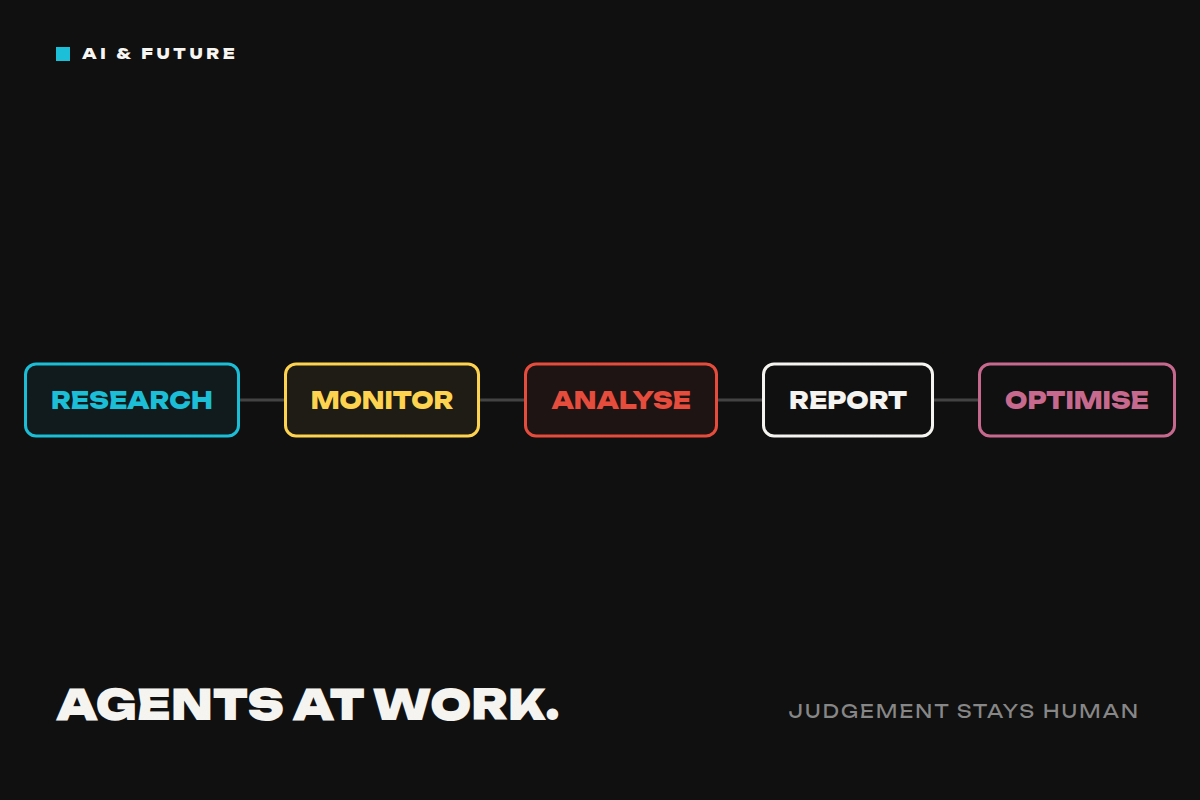
The next wave of AI in marketing isn’t a better writing assistant. It’s software that works — agents that take a goal, break it into steps, use tools, and come back with the job done.
What agents will actually do
Picture the repetitive layer of any marketing team’s week: pulling performance data into reports, monitoring competitors’ launches and pricing, watching sentiment in comments, organising content calendars, flagging campaigns that need budget shifts, drafting first-pass analyses. All of it is structured, rule-based and constant — exactly the work agents are built for. Teams that adopt them will spend dramatically less time assembling information and more time acting on it.
Agents will do the work about the work. The work itself still needs a point of view.
What stays human
An agent can report that engagement dropped. It takes judgement to know whether that’s creative fatigue, the wrong audience, or a competitor’s campaign stealing attention — and what to do next. An agent can assemble a content calendar; it cannot decide that this Ramadan the brand should say something braver. Strategy, taste, cultural reading, client trust, creative direction — the closer a task sits to “what should we do and why,” the more human it remains.
How to prepare without the hype
Start small and specific: automate one report, one monitoring task, one repetitive workflow. Keep a human reviewing outputs — agents are confident even when wrong. And invest in the skills agents amplify rather than replace: clear strategy, strong creative standards, and clean data for the agents to work with. Brands with messy foundations will simply get messy work done faster.
What this means for brands
Don’t buy the fantasy that marketing runs itself now. Do take seriously that the cost of the routine layer is collapsing. The winning setup for the next few years looks the same everywhere: agents handling the repetitive layer, people making the calls that matter. Teams that get that balance right first will simply move faster than everyone else.

AI Can Create Content. So Why Do Brands Still Need Creative Teams?
Let’s be honest about something agencies don’t always say out loud: AI can now produce in minutes what used to take days. We use it ourselves. So the question clients ask is fair — if AI can generate the content, what exactly are we paying a creative team for?
What AI actually gives you
Volume, speed and competence. AI can draft captions, explore visual directions, produce variations, summarise research. The floor of acceptable content has never been higher or cheaper. But notice what happened the moment everyone got the same tools: everyone’s content started converging. Same phrasing, same look, same safe middle. When production is infinite, production stops being the advantage.
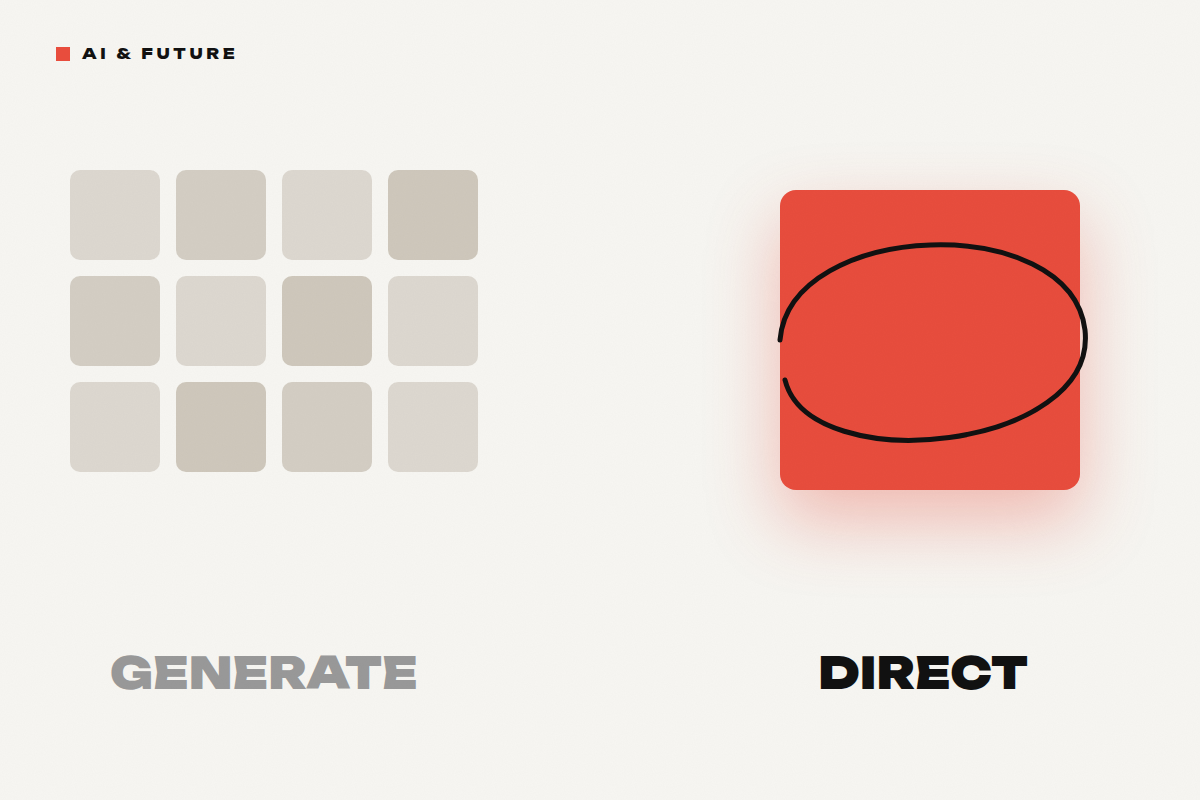
AI raised the floor. Taste is now the ceiling.
What AI doesn’t bring
Strategy: knowing what this brand, in this market, at this moment, should say — and should refuse to say. Cultural understanding: what resonates in Riyadh during Ramadan, what falls flat, what offends. Taste: choosing the one strong option from a hundred plausible ones. Art direction: the deliberate consistency that makes a brand recognisable. Judgement: knowing when the technically fine output is still wrong. These are exactly the things that decide whether content builds a brand or just fills a feed — and they don’t come with the subscription.
How we actually use it
At Ideative, AI supports research, ideation, exploration and production assistance. It makes our teams faster. It has never once decided what a campaign should stand for, or looked at a finished shoot and said “this frame — this is the one.” The tools generate. People direct.
What this means for brands
Use AI — seriously, do. But understand what game changed: when everyone can produce, distinctiveness becomes the scarce asset. The brands that win the AI era won’t be the ones that generate the most content. They’ll be the ones with the clearest point of view about what’s worth publishing.
SEO vs GEO vs AEO: What Brands Need to Know
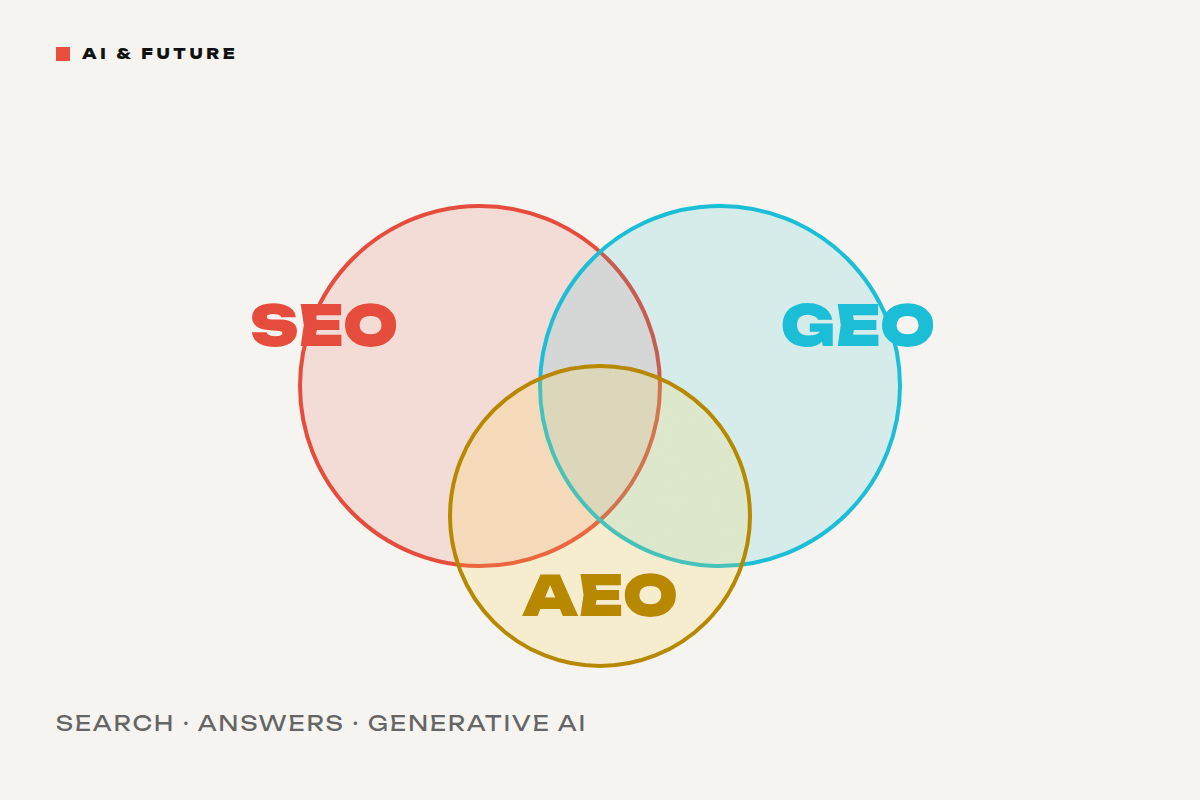
SEO gets you found in search engines. AEO gets your content used as the direct answer. GEO gets your brand understood — and mentioned — by generative AI. They stack; they don’t compete.
“Why isn’t my company appearing when I ask ChatGPT for recommendations?” A client asked us this last year, and it is quietly becoming one of the most important questions in marketing.
SEO — the classic layer
Search Engine Optimisation is the discipline you know: making your site technically sound, fast, structured and genuinely useful so search engines rank it. It still matters enormously — search engines remain a primary source of discovery, and everything else builds on this foundation.
AEO — the answer layer
Answer Engine Optimisation targets the moment when the user never clicks: featured snippets, answer boxes, voice assistants. It rewards content structured as direct answers — clear questions, concise responses, FAQ formats, structured data. If SEO is about being listed, AEO is about being quoted.
GEO — the generative layer
Generative Engine Optimisation is the newest: helping AI systems like ChatGPT, Gemini and Perplexity understand who you are, what you do, and why you are credible — so that when someone asks for “the best product photography in Riyadh,” your brand is part of the answer. It depends on a clear digital entity: consistent company information everywhere, authoritative content, real third-party mentions, reviews, and structured pages machines can parse confidently.
SEO gets you ranked. AEO gets you quoted. GEO gets you recommended.
What this means for brands
Don’t abandon SEO for the shiny new acronym — the three layers share the same foundation: clear structure, honest expertise, consistent information and content that answers real questions. Build that once, and every kind of search benefits. No agency can guarantee an AI will recommend you; anyone promising that is selling something else. What can be built is the foundation that makes recommendation possible.
Deeper dive: our GEO guide for the Saudi market.
GEO is the new SEO: how Saudi brands get recommended by AI in 2026
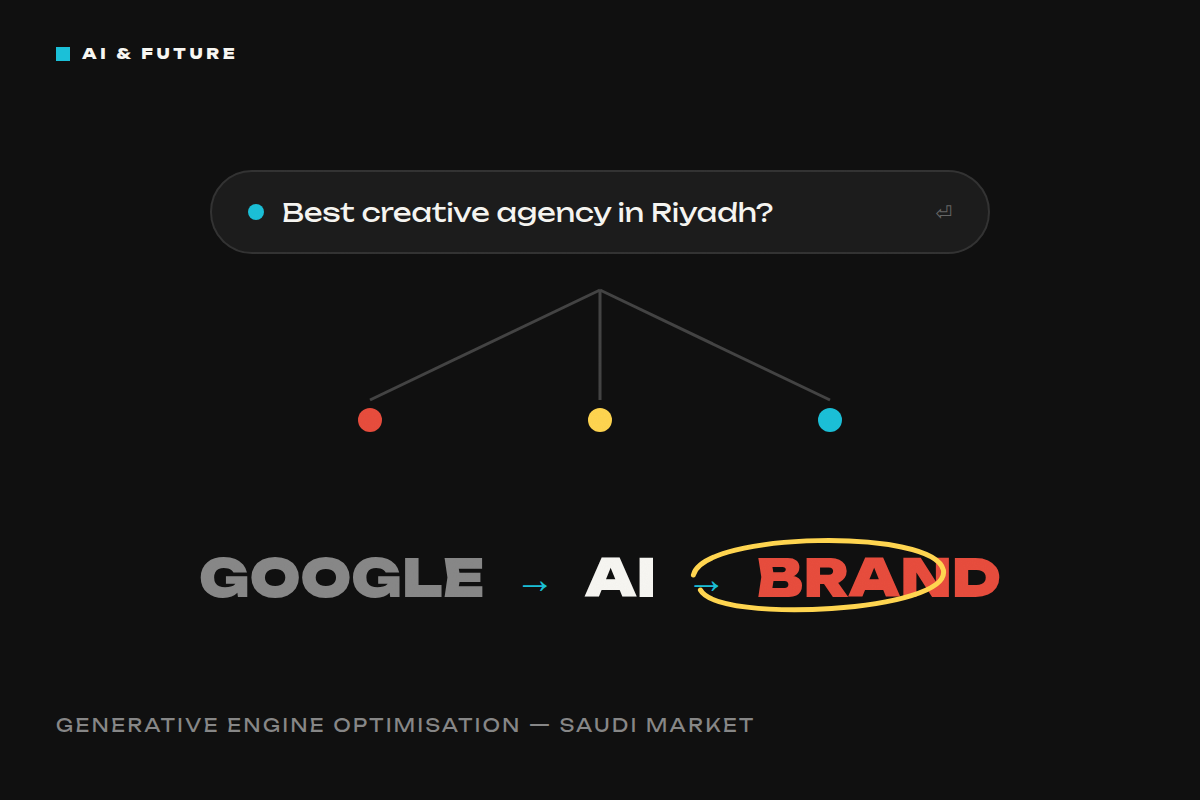
Ask yourself a simple question: when a customer in Riyadh asks an AI assistant "who is the best coffee brand in Saudi?" — does your name come up?
Search changed. A growing share of discovery now happens inside AI answers, not in a list of ten blue links. That shift created a new discipline: Generative Engine Optimization (GEO) — making sure AI engines know who you are, what you do, and why you are credible enough to recommend.
Why GEO matters in Saudi right now
Saudi Arabia has one of the highest AI-adoption rates in the region. Your customers ask AI for restaurant picks, agency shortlists, product comparisons and gift ideas — in Arabic and English. Brands that are invisible to AI engines are quietly losing recommendations every day, and they never see it in their analytics.
What actually moves the needle
1. Structured, factual content. AI engines trust pages that state clearly what you do, where you operate, and what you have done — with schema markup underneath.
2. Bilingual authority. Publish real answers in Arabic and English. AI pulls from both, and most of your competitors only write in one.
3. Consistent entity signals. Same name, same description, same links across your website, Google Business Profile, LinkedIn and press mentions. AI cross-checks.
4. Proof, not adjectives. "5M+ organic views from a single campaign" beats "we are creative and passionate" — engines quote numbers.
How we build GEO into every website
At Ideative we bake GEO into the foundations: clean structure, bilingual content, Organization and Service schema, FAQ pages written the way people actually ask, and case studies with real results. The goal is simple — when someone asks AI for the best at what you do, the answer is you.
Want a GEO audit of your brand? Talk to us.